

Imagine this: you’re standing on Waikiki Beach, the Pacific breeze in your hair, ready to sync your stride to the perfect playlist. You reach for your earbuds, but a nagging thought hits you—will they survive the salt, the sand, and the sudden splash? You’ve been burned before by “water-resistant” claims that didn’t hold up. The struggle is real, and finding gear that keeps up with island life isn’t just about sound quality; it’s about durability and peace of mind. In this guide, we’ll navigate the murky waters of IP ratings, fit, and battery life to ensure you choose waterproof earbuds Hawaii beach conditions demand, so you can focus on the sunset, not your tech.
Selecting earbuds for Hawaii isn’t a one-size-fits-all decision. The unique combination of ocean water, abrasive sand, and intense tropical sun requires specific features that standard gym earbuds simply don’t offer. We’re here to cut through the marketing noise and give you a clear, practical roadmap. By the end of this article, you’ll know exactly which specs matter most, how to secure a sweat-proof fit, and the specific pitfalls to avoid before your next island adventure.
Why Standard Earbuds Fail in Hawaii’s Harsh Environment?
Hawaii’s beaches are paradise, but they are a hostile environment for consumer electronics. The primary threats are crystalized salt, which is corrosive, and fine volcanic sand, which acts like sandpaper on delicate meshes and charging ports. Standard earbuds, even those marketed as “sweat-resistant,” lack the sealed enclosures needed to keep these elements out, leading to degraded audio and premature failure.
The Corrosive Nature of Saltwater vs. Freshwater
Most earbuds are tested with pure freshwater. Saltwater is a far more aggressive electrolyte that rapidly accelerates metal corrosion. When saltwater dries, it leaves behind salt crystals that can short-circuit internal components. You can’t just rinse them off without care, making the initial IP (Ingress Protection) rating crucial. A true waterproof rating (IPX7 or IP68) ensures the internal components are sealed against immersion, not just splashes.
The Abrasive Reality of Beach Sand
Sand is the silent killer of earbuds. Tiny grains can clog the mesh covering the drivers, reducing volume and muddying the bass. Worse, sand can jam the button mechanisms or scratch the outer casing. A robust, rugged build with a hydrophobic nano-coating is essential. You need earbuds designed to be wiped clean, not scrubbed, and resilient enough to withstand being jostled in a beach bag.
Understanding IP Ratings: What Actually Matters?
An IP rating is your first line of defense. Look for the “IP” (Ingress Protection) code: the first digit is for solid particles (dust/sand), and the second is for liquids. For beach use, you want a minimum of IP67 (dust-tight and protected against immersion in 1 meter of water for 30 minutes) or IP68 (protected against continuous immersion deeper than 1 meter).
- IPX4: Splash-resistant only. Not enough for beach waves.
- IPX6: Powerful water jets. Good for heavy rain, but not immersion.
- IP67/IP68: True waterproofing. Essential for ocean dips.
If you love enjoying music while traveling or moving around the city, you might also want to check out our guide on how to choose the right gear for your transit routine Best Earbuds for Daily Commute in PA.
Which Earbud Design is Best for Snorkeling and Surfing?
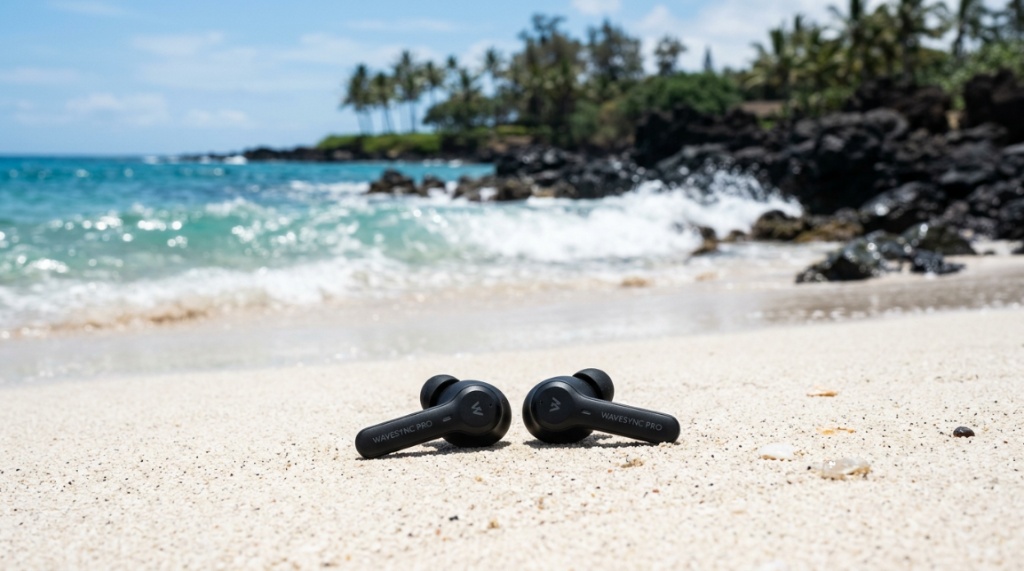
Your activity dictates your design choice. For surfers or open-water swimmers, a secure, behind-the-ear hook design is non-negotiable to prevent loss in the waves. For casual beach loungers who might occasionally dip their heads to cool off, a standard in-ear design with a high IP rating and a snug fit is often more comfortable and discreet.
Ear Hooks vs. True Wireless: Stability and Security
Ear hooks or fins provide a physical anchor that keeps the buds in place during high-impact activities like bodyboarding or snorkeling. True wireless earbuds are convenient, but if they fall out in the surf, they are nearly impossible to find. The decision hinges on your tolerance for risk and the intensity of your water activities.
| Feature | Ear Hook Style | True Wireless |
|---|---|---|
| Security | High (anchored around ear) | Medium (relies on tip seal) |
| Comfort | Bulkier, can cause fatigue | Compact, lightweight |
| Best For | Surfing, running, intense workouts | Lounging, casual walks, travel |
| Risk Factor | Larger to pack | High risk of loss in water |
Bone Conduction: A Safe Alternative for Awareness
If you need to hear the environment (oncoming surf, boat traffic, or a friend calling out), bone conduction headphones are a valid choice. They leave your ear canals open. However, they are not great for blocking out the sound of crashing waves if you want to be immersed in music. You should search specifically for models with a high IP68 rating, as many bone conduction units are only sweat-proof, not swim-proof.
Earbuds vs. Headphones: The Portability Factor
For a beach day, you want to pack light. On-ear or over-ear waterproof headphones are often bulky and heavy. Earbuds win this category by a landslide. They fit inside a small pocket in your swim trunks or a tiny dry bag. This portability, combined with a charging case that doubles as a power bank, makes earbuds the superior choice for the beach.
How to Ensure a Perfect, Leak-Proof Fit for Swimming
Water and sound don’t mix well. If water gets into your ear canal, it creates a barrier that muffles audio. A leak-proof seal is critical for maintaining bass response and clarity underwater. This is achieved through the correct selection of ear tips. Silicone tips offer a balance of comfort and seal, while foam tips expand to fill the ear canal, but they are terrible for water retention (they get soaked).
Choosing the Right Ear Tip Size and Material
You should opt for multi-layer silicone tips designed for swimming. These have a patented design that prevents water column pressure from reaching your eardrum. Always test fit the largest tip that fits comfortably. A smaller tip will leak water and cause audio to become tinny. Spending time on this fit test is the single most important step for underwater audio success.
Stabilizing with Fins and Wings
Beyond the tip, stability wings (or fins) fit into the concha (the bowl-shaped part of your outer ear) to hold the earbud in place. This prevents the bud from being dislodged by the force of a wave. If your chosen model doesn’t include fins, and you plan to swim laps or bodyboard, consider a third-party rubber sleeve that adds grip.
The “Ear Dry” Trick: Prepping Your Ears
To allow the ear tip to seal properly, you need to ensure you don’t have water trapped inside the ear canal before insertion. A simple shake of the head, followed by a careful drying with a towel corner, can clear the outer canal. Some swimmers also use a drop of rubbing alcohol to displace water and dry the ear quickly—just ensure it is fully evaporated before inserting the earbuds to avoid irritation.
What Battery Life Do You Need for a Full Beach Day?
A full day in Hawaii, from sunrise to sunset, is roughly 12 to 14 hours. You won’t wear earbuds the entire time, but you need to account for continuous play during long hikes to the beach, the flight, and the poolside lounging. Relying solely on the earbuds’ internal battery is a gamble; the charging case is your safety net.
Calculating Playtime vs. Charging Case Capacity
Look for a total playtime (buds + case) of at least 24 hours. The buds themselves should last between 6 to 10 hours on a single charge. The critical feature here is the case size and battery capacity. A bulky case using a USB-C connection is more convenient than a proprietary connector, as you can charge it with the same cable as your phone. Look for models that offer quick-charge (e.g., 10 minutes of charge = 1 hour of play) for emergency top-ups.
Fast Charging: The “Grab and Go” Necessity
When you’re heading out for a spontaneous dip, waiting 45 minutes for a full charge is a pain. Fast charging is non-negotiable. More importantly, check if the case supports wireless charging. If you’re staying at a resort, you can simply toss the case onto a wireless pad by the pool—this keeps it topped up without dealing with cables near water.
Power Bank Integration in the Charging Case
Some premium “sports” earbuds offer cases with a USB port to charge your phone in an emergency. This is a massive advantage for a full beach day, as it eliminates the need to bring a separate external battery. While it adds weight, it simplifies your carry and ensures your phone isn’t dead for photos on the way back to the rental.
Can You Use Touch Controls with Wet Fingers?
Wet fingers and sandy hands are terrible for capacitive touch controls. Physical buttons are far more reliable in wet conditions. However, many flagship models have moved to touch. If you are considering touch controls, you need to ensure they have high sensitivity settings or a “glove mode” that makes them easier to trigger, but expect accidental pauses when adjusting your hair or wiping water away.
The Case for Physical Buttons
Physical buttons click. They provide tactile feedback. When you’re paddling a board or dealing with a stinging jellyfish, you don’t want to fumble with a tiny panel. A physical button lets you pause or skip tracks without perfect finger placement. The downside is that pressing them can push the earbud further into your ear, so they need to be well-anchored with the fins discussed earlier.
Managing “Watch” Controls for Convenience
If you’re already wearing a smartwatch, the easiest way to control music without touching your earbuds is via the watch. You can adjust volume and skip tracks from your wrist, keeping your hands free and your earbuds dry. This bypasses the touch control issue entirely and is the strategy we recommend for surfing or active swimming.
Guardian Angel: The Transparency Mode
Even with waterproofing, you should be aware of your surroundings. Look for a “Transparency” or “Ambient” mode. This uses the microphones to let outside sound in. When you’re at a crowded beach with kids or navigating a boat ramp, pausing the music and enabling transparency is a safety feature that works effectively even if the earbuds themselves don’t have the best touch response.
How to Maintain and Rinse Your Earbuds After Saltwater Exposure
Rinsing is an essential post-beach ritual. Do not place your earbuds directly under a high-pressure tap. Instead, use a bowl of fresh water. Swish them gently for 10-15 seconds. Do not use soap, as the chemicals can degrade the waterproof membrane over time. After rinsing, dry the exterior with a soft, lint-free cloth.
The “Shock” Drying Method: Removing Excess Water
Sharply shake the earbuds in a downward motion with the earbud tips facing down. This uses centrifugal force to eject any trapped water from the nozzle. Do not use compressed air, as this can force water deeper into the acoustic mesh. Allow them to air-dry for at least 30 minutes before placing them in the charging case. Charging while wet is a leading cause of case failure.
Cleaning the Mesh: The Toothbrush Trick
Salt crystals and sand will clog the mesh. Use a dry, soft-bristled toothbrush (or a dedicated brush) and gently sweep across the mesh at a 90-degree angle. Do not poke the mesh. If the mesh is debris-laden, you can use a tiny piece of blu-tack or specialized cleaning compound to gently pull the particles out.
Case Maintenance: The Sand Trap
The charging case is the most vulnerable component. Sand will wedge between the lid and the base, preventing a solid seal. Before closing the case, tap it upside down on a hard surface to dislodge loose grains. Check the charging pins for debris. If the pins are crusty, use a wooden toothpick to carefully scrape them clean.
When Should You Buy New vs. Repairing Old Earbuds?
If your earbuds have survived multiple beach trips but are starting to sound muffled or have a fading battery, repairs are often more costly than replacement. Waterproof earbuds have sealed units; they are not designed to be disassembled. Attempting to repair them often destroys the waterproof integrity. The moment you open the casing, the IP rating is void.
The Indispensability of a Warranty
Always check the warranty. Some reputable brands offer a 2-year warranty that includes water damage, even from saltwater. This is invaluable. Reading the fine print is crucial. Does the warranty require a proof of purchase? Do they cover “accidental” damage? A strong warranty is a sign of a manufacturer confident in their waterproofing.
Signs It’s Time to Upgrade
If you notice the volume levels dropping drastically, or if the left and right earbuds sound unbalanced after a rinse, the internal drivers may be compromised. If the charging case connector pins seem to short out frequently, it’s time to shop. Investing in newer models with better efficiency and higher IP ratings is often the smarter financial decision.
If you are still unsure which specific model fits your budget and needs, we have curated a list of top performers that excel in tropical environments. Check out this detailed comparison of the best waterproof earbuds Hawaii beach enthusiasts recommend to avoid trial and error.
What Are the Top Features to Prioritize for Wind and Surf Noise?
Hawaii’s trade winds are constant. Microphone quality and audio processing are necessary for clear phone calls. A standard microphone will pick up wind noise, making you sound like you’re in a hurricane. When evaluating earbuds, look for specific wind-reduction technology, often involving a specialized mesh layer over the microphones.
Microphone Quality for Phone Calls
Bone conduction microphones are superior for calls in windy environments. They pick up vibrations of your voice through your skull, ignoring the ambient wind. If you plan to call family back home while walking on the beach, prioritize earbuds with multiple microphones that use software algorithms to isolate your voice, rather than just relying on one tiny pinhole mic.
EQ Settings for the Ocean’s Roar
Water is a sound absorbent. Underwater, you lose most of the high-end frequencies, making music sound muddy. Look for earbuds with a companion app that allows you to adjust the EQ. When swimming, boost the treble and cut the bass slightly to compensate for the underwater acoustics. This results in a much clearer, brighter sound profile.
Multipoint Connectivity
Multipoint connectivity lets you stay connected to both your tablet and phone simultaneously. This is useful if you have a movie playing on your tablet but want to take a call on your phone. While not strictly water-related, it is a convenience feature that reduces the need to fiddle with settings while managing beach gear.
Is Active Noise Cancellation (ANC) Useless on the Beach?
Not useless, but you must use it carefully. ANC is excellent for reducing the drone of an airplane engine or a buzzing AC unit. On the beach, it will reduce the roar of the waves and the hum of wind, which can be relaxing. However, it cannot stop the sound of a child crying or the scream of a fellow beachgoer—those are mid-frequency sounds that ANC struggles with.
Transparency vs. ANC: The “Beach Mode”
You will likely be toggling between ANC and Transparency. In the water, ANC can make you feel isolated and slightly disoriented. On land, it’s great for quiet relaxation. Some apps allow you to set a “custom” mode. We recommend setting a specific “beach mode” that has a mild ANC level, not the maximum setting, so you are still partially aware of your immediate environment.
The Impact of ANC on Battery Life
Running ANC drains the battery faster. If you are on a long beach day and relying on the charging case, you may want to turn ANC off when you don’t need it. The difference between ANC on and ANC off can be 20-30% of battery life. A smart feature to look for is “adaptive ANC,” which automatically adjusts the noise cancellation level to the environment, saving power when it isn’t needed.
Frequently Asked Questions
Can I wear waterproof earbuds while scuba diving?
No. Most waterproof earbuds are rated for swimming or snorkeling at depths of 1-2 meters. Scuba diving involves pressure changes that will crush the internal components. You need specialized underwater audio gear that can withstand depths exceeding 10 meters.
How do I dry the charging case after it gets wet?
Wipe it dry with a towel immediately. Do not open the lid to place earbuds inside if they are dripping. Leave the lid open and place the case in a dry, well-ventilated area away from direct sunlight for 24 hours before charging.
Does the warranty cover saltwater damage?
This varies by brand. Many major brands, such as JBL and Jabra, have specific clauses regarding water damage. However, “water damage” often includes saltwater. Always read the warranty terms to understand the specific coverage limits.
Are foam ear tips good for swimming?
No. Foam tips soak up water like sponges. They will lose their shape, become uncomfortable, and take a long time to dry, potentially growing mold. Use silicone or medical-grade rubber tips for water activities.
What is the difference between IPX7 and IP68?
IPX7 means the device can withstand immersion in 1 meter of water for 30 minutes. IP68 ensures protection against continuous immersion beyond 1 meter. For normal swimming and snorkeling, IPX7 is sufficient; IP68 offers a better margin of safety.
Can I use my normal earbuds if I just stay on the sand?
Even on the sand, dust and humidity are threats. Sand is a particle which can scratch the casing and clog the mesh. Humidity can corrode the internal circuits over time. We recommend using waterproof earbuds to ensure they last longer in tropical climates.
Conclusion: Don’t Let Tech Ruin Your Paradise
Finding the perfect audio companion for Hawaii beach beach days doesn’t have to be a chore. You now know the crucial difference between water-resistant and waterproof, the importance of a secure fit, and the diligence required to flush out salt and sand. The island lifestyle is about ease and enjoyment, and your tech should match that vibe.
Your next step is straightforward: take the knowledge from this guide and shortlist a few top-tier models. Prioritize durability, battery life, and a robust warranty. Pack your new earbuds, embrace the aloha spirit, and let the soundtrack of your trip be as vibrant and clear as the turquoise water. Hit the horizon with confidence—your gear is ready for whatever the ocean throws at it.