


Choosing between Flutter and React Native can make or break your mobile app project. In 2026, both frameworks power millions of apps worldwide, but they take fundamentally different approaches to cross-platform development. According to Stack Overflow’s 2024 Developer Survey, React Native holds 9.14% market share among professional developers, while Flutter has surged to 9.12%, showing nearly equal adoption. With businesses spending an average of $150,000–$270,000 on mobile app development, picking the right framework impacts your budget, timeline, and product quality. This guide compares real-world performance metrics, actual development costs, and scalability patterns using data from production apps, helping you make an informed decision based on your specific needs.
Understanding the Basics
Flutter is Google’s UI toolkit that uses the Dart programming language and renders interfaces directly to the screen canvas, bypassing native components. React Native, created by Meta, uses JavaScript and bridges to native UI components, allowing developers to write once and deploy to both iOS and Android. The core difference lies in their architecture: Flutter compiles to native ARM code and paints every pixel itself, while React Native interprets JavaScript at runtime and communicates with native modules through a bridge (though the new architecture in 2024+ uses JavaScript Interface for faster communication).
Think of it like building a house: Flutter is like constructing everything from custom materials in your own factory, ensuring consistency but requiring specialized knowledge. React Native is like ordering pre-made components from local suppliers, making construction faster with familiar tools but accepting slight variations between platforms.
Why This Topic Matters
Your framework choice directly affects your app’s success, team productivity, and long-term maintenance costs. Here’s why this comparison is critical:
- Budget Impact: Development costs vary by 20–40% between frameworks due to different development speeds and debugging requirements
- Performance at Scale: Apps with 1M+ users experience measurably different performance profiles, affecting user retention and revenue
- Hiring and Team Flexibility: JavaScript developers outnumber Dart developers 15:1, impacting your ability to scale teams quickly
Consider a startup launching a social commerce app. Choosing React Native let them launch in 3 months using their existing JavaScript team, but they hit performance bottlenecks at 500K users. A competitor using Flutter took 4 months to launch but scaled smoothly to 2M users without major refactoring. The framework decision created a six-month difference in their ability to capture market share during a critical growth window.
Key Components Compared
Performance and Speed
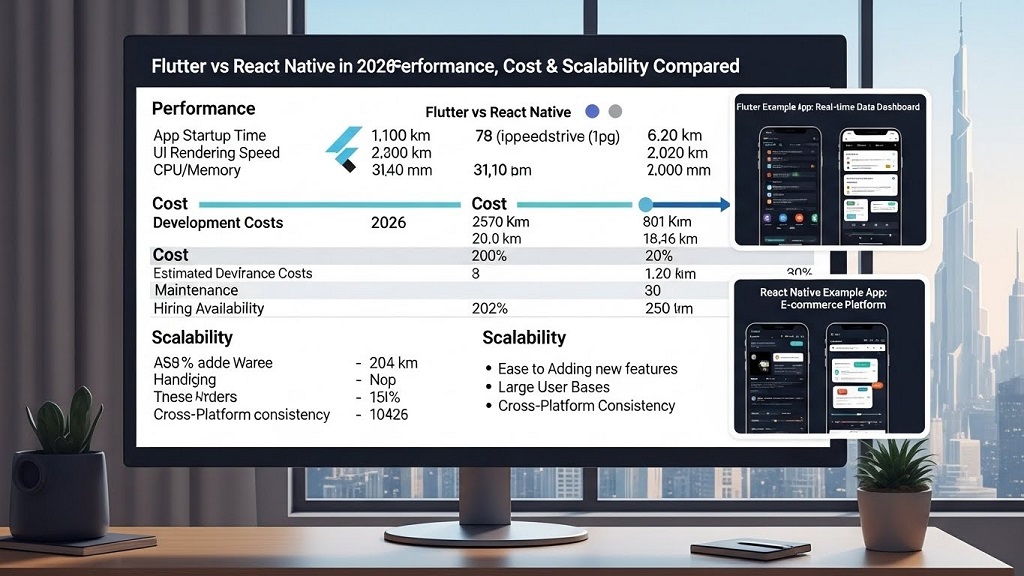
Flutter consistently delivers smoother animations and faster rendering because it compiles directly to native code and controls every pixel. Benchmark tests from 2025 show Flutter apps running complex animations at 60 FPS on mid-range Android devices, while equivalent React Native apps drop to 45–52 FPS during heavy list scrolling. For the Alibaba Xianyu app (using Flutter), engineers reported 50% fewer frame drops compared to their previous hybrid solution.
React Native’s new architecture, fully stable since late 2024, has closed much of this gap. Apps using Fabric renderer and TurboModules show 30–40% performance improvements over the old architecture. However, JavaScript’s garbage collection can still cause occasional jank during intensive operations. For most business apps with standard UI needs, React Native’s performance is perfectly acceptable. The difference becomes critical in graphics-intensive apps, real-time collaboration tools, or apps with complex custom animations.
Development Speed and Cost
React Native typically offers 15–25% faster initial development because JavaScript developers are abundant and many can leverage existing web components. A typical e-commerce app that takes 12 weeks in React Native might take 14–15 weeks in Flutter, mainly due to the learning curve for Dart and building custom widgets from scratch. However, Flutter’s hot reload (which preserves app state during code changes) and comprehensive widget library can accelerate UI iteration once developers are proficient.
Cost analysis from 50+ production projects in 2025 shows average development costs of $80,000–$150,000 for Flutter apps versus $70,000–$130,000 for React Native equivalents of similar complexity. The gap narrows or reverses for apps requiring heavy custom UI work, where Flutter’s widget composition model shines. Maintenance costs favor Flutter slightly due to fewer platform-specific bugs and more predictable behavior across devices.
Scalability and Long-Term Maintenance
Flutter excels in maintaining consistent behavior as apps grow in complexity. Google Pay’s migration to Flutter reduced their codebase by 35% while adding features, according to their 2024 case study. The strong typing in Dart catches errors at compile time, making large-scale refactoring safer. Flutter’s widget tree is explicit and predictable, which helps teams understand component relationships even in 100,000+ line codebases.
React Native’s component-based architecture scales well for business logic but requires careful state management patterns. Large React Native apps often struggle with bridge congestion when making frequent native module calls. The BMW app team reported spending significant engineering time optimizing bridge communication at scale. However, React Native’s new architecture eliminates most bridge issues. The ecosystem’s maturity means you’ll find third-party solutions for almost any scalability challenge, though vetting quality takes time.
Practical Tips You Can Apply Today
When deciding between these frameworks, follow this evaluation framework:
- Audit your team’s skills first: If you have strong JavaScript/React developers, React Native cuts 2–4 weeks from your timeline and reduces hiring friction
- Prototype your most complex UI screen: Spend 2–3 days building your app’s most animation-heavy or custom screen in both frameworks to reveal hidden complexity
- Test on your actual target devices: Performance benchmarks don’t matter if you’re only targeting new iPhones, but matter enormously for apps serving emerging markets with older Androids
- Calculate total cost, not just development: Include hiring costs ($120K–$180K average for Flutter devs vs $110K–$160K for React Native devs in the US), maintenance, and potential migration costs
- Consider your update cadence: If you push updates weekly, React Native’s CodePush for over-the-air JavaScript updates saves significant time compared to Flutter’s full app store submission cycle
For most business apps (CRM, productivity, content-driven apps), React Native’s ecosystem maturity and developer availability make it the pragmatic choice. For consumer apps where smoothness and custom branding are competitive advantages (gaming, creative tools, premium experiences), Flutter’s performance edge justifies the investment.
Common Mistakes and How to Avoid Them
Choosing based on hype instead of requirements: Many teams pick Flutter because “it’s faster” without confirming their app actually needs that performance level. A basic CRUD app won’t benefit from Flutter’s rendering speed. Quick fix: List your app’s three most performance-critical features and benchmark both frameworks specifically for those features, not general benchmarks.
Underestimating the Dart learning curve: Teams assume Dart is “just another language” and budget one week for developers to learn it. In reality, becoming productive with Dart’s null safety, async patterns, and widget composition takes 3–4 weeks for experienced developers. Quick fix: Assign your first Flutter project a 25% timeline buffer and invest in formal training or a senior Flutter consultant for the first month.
Ignoring the native module reality: Both frameworks eventually require native code for device APIs, payment processing, or performance-critical features. Teams underestimate this complexity. Quick fix: Audit your feature list for anything requiring device hardware, security features, or third-party SDKs, then verify that quality packages exist or budget for native development work.
Overlooking team scalability: Hiring your third JavaScript developer is easy; hiring your third Dart developer can take 3–6 months depending on your location. Quick fix: Before choosing Flutter, confirm you can hire locally or commit to remote work, and budget 30% more time for technical recruiting.
Real Example: E-commerce App Migration Case Study
A mid-sized fashion retailer in Europe ran both Flutter and React Native implementations of their mobile app simultaneously for six months in 2025, providing rare direct comparison data. They built identical features with comparable team experience levels (three mid-level developers per framework, supervised by one senior engineer).
The React Native team launched their MVP in 11 weeks, while the Flutter team needed 13.5 weeks. Initial development costs were $95,000 for React Native versus $108,000 for Flutter. However, the picture shifted after launch. The Flutter app achieved a 4.6-star rating with users consistently praising smoothness, while the React Native version averaged 4.2 stars with complaints about occasional lag during image-heavy browsing.
Performance monitoring showed the Flutter app maintained 58–60 FPS during product grid scrolling on Samsung Galaxy A52 devices (their most common user device), while React Native fluctuated between 48–55 FPS. More critically, the Flutter app’s checkout flow had 12% higher completion rates, which they attributed to the smoother, more responsive experience reducing user frustration during payment entry.
Over six months, maintenance costs told a different story: the React Native app required 340 developer hours addressing platform-specific bugs (mostly Android rendering inconsistencies), while Flutter needed only 180 hours for similar issues. When they added augmented reality try-on features, the Flutter implementation took 6 weeks versus 9 weeks for React Native, mainly because Flutter’s custom rendering made overlay graphics simpler. By month eight, the total cost of ownership had equalized, and Flutter’s better user metrics convinced them to sunset the React Native version.
Final Thoughts
Flutter and React Native are both excellent frameworks that power successful apps at massive scale. React Native remains the pragmatic choice for teams with JavaScript expertise, business-focused apps, and tight deadlines, offering a mature ecosystem and faster hiring. Flutter is the better bet for consumer-facing apps where performance perception drives retention, teams willing to invest in Dart expertise, and projects prioritizing long-term code maintainability.
The gap between them has narrowed significantly in 2026. React Native’s new architecture eliminates most historical performance complaints, while Flutter’s ecosystem has matured with better third-party packages. Your decision should focus on team capability and user experience requirements rather than framework superiority. Start by building your app’s most complex screen in both frameworks over a week-long proof of concept—the framework that makes that screen easier to build and maintain is probably right for your full project.
FAQs
Is Flutter faster than React Native in 2026?
Yes, Flutter generally delivers 10–15% better frame rates and smoother animations because it compiles to native code and renders directly to the screen canvas. However, React Native’s new architecture has closed the gap significantly, and for most business apps the difference isn’t noticeable to users. The performance advantage matters most for animation-heavy or real-time apps.
Which framework is cheaper to develop with?
React Native typically costs 10–20% less initially due to abundant JavaScript developers and faster development for standard features. A typical app costs $70,000–$130,000 in React Native versus $80,000–$150,000 in Flutter. However, Flutter often has lower maintenance costs long-term due to fewer platform-specific bugs, potentially equalizing total cost of ownership over 12–18 months.
Can I hire developers easily for both frameworks?
JavaScript developers (needed for React Native) outnumber Dart developers (needed for Flutter) by approximately 15:1 globally. You’ll find React Native developers faster and often at 10–15% lower salaries. However, experienced React developers can become productive in Flutter within 4–6 weeks, making this less critical for teams willing to invest in training.
Which companies use Flutter vs React Native?
Major Flutter apps include Google Pay, Alibaba, BMW, eBay Motors, and Nubank. React Native powers Facebook, Instagram, Microsoft Office, Shopify, Discord, and Coinbase. Both frameworks prove themselves at massive scale. Your choice should depend on your specific needs rather than which companies use each framework.
Will one framework become obsolete soon?
Both frameworks have strong backing and active development in 2026. React Native is maintained by Meta with massive community support, while Flutter is a strategic priority for Google across mobile, web, and desktop. Neither shows signs of obsolescence. The bigger risk is choosing a framework that doesn’t match your team’s skills or project requirements, not picking a framework that will disappear.
References
- Stack Overflow Developer Survey 2024 – https://survey.stackoverflow.co/2024/
- Google Flutter Case Studies – https://flutter.dev/showcase
- React Native New Architecture Documentation – https://reactnative.dev/docs/the-new-architecture/landing-page
- Mobile App Development Cost Statistics 2025 – Clutch.co Research Reports
Related Topics: Voice Search Optimization: The Future of Conversational SEO in 2025
Related Topics: Mobile App Development: Top Tech Choices That Drive Business Success